Build your AI second brain: stop starting from scratch with AI

Kaiyan Ali
Founder at Montaj Digital

Kaiyan Ali
Founder at Montaj Digital
I'm Kaiyan, founder of Montaj Digital. I help professional service firms put AI and automation to work, so their people spend less time on admin and more on the work only humans can do. I've trained 250+ professionals at our AI Week, and I'm on a mission to help a million service firms do the same.
Follow me for more contentMost businesses are using AI like a scratchpad. They open ChatGPT, Claude or Gemini, explain the same background again, get something half useful, copy it somewhere, then repeat the whole thing a week later.
That isn't really an AI problem. It's a context problem. The tools are strong enough now that the advantage isn't who has the cleverest prompt. The advantage is who has the clearest business context for the AI to work from.
I recorded this workshop to show the system behind my own AI second brain at Montaj. Watch the replay below, then use the article as the written version. If you want help choosing your first layer, book a free AI readiness call.
What an AI second brain is
An AI second brain is a context layer your business owns. In practical terms, it's a set of files and rules that tell AI what your business knows, where that knowledge came from, what has been reviewed, and what should still be treated as uncertain.
The point isn't to build something that looks technical. My own brain looks impressive in Obsidian because the graph view shows all the connections, but underneath it's just folders and Markdown files. The method is the value: sources, reviewed knowledge, an index, a log and clear rules for how the brain changes.
- Sources are the original evidence: calls, transcripts, proposals, notes, emails, SOPs and reference documents.
- Reviewed knowledge is the useful version of those sources, written in plain English so AI and humans can both use it.
- The index tells AI where to look instead of forcing it to read every file and burn context.
- The log records decisions and changes, so old assumptions don't quietly pretend to be current.
The model isn't the moat
The best model keeps changing. One week it feels like Claude is ahead. Then ChatGPT ships a new model. Then Gemini does something useful with files, video or Workspace. If all your business knowledge is trapped inside one platform, you're stuck moving at the pace and price of that platform.
A second brain gives you something portable. You can point ChatGPT, Claude, Codex or another compatible tool at the same underlying context and pick up where you left off. That matters because the real advantage is no longer access to a twenty pound a month model. Everyone has that. The advantage is your pricing logic, client history, delivery standards, positioning, proof, team rules and judgement.
Where business context gets lost
During the workshop I asked people to think about where their useful business knowledge already lives. For most owners, the answer is messy because the business is messy. Some of it is in your head. Some is in Google Drive, Slack, Notion, Gmail, Fathom, CRM notes, WhatsApp, old proposals and half-finished process docs.
That scattered knowledge creates the same friction everywhere. Proposals take longer because the pricing logic has to be rebuilt. Team members ask the same questions because the standard isn't written down. AI outputs sound generic because the model can't see your actual clients, your actual offers or what good looks like in your business.
The operating system model
A useful AI operating system needs four parts: context, connections, capabilities and review. Context is what the brain knows. Connections are the routes into the places where new information appears. Capabilities are what the AI can do once it has enough context. Review is the human layer that stops the system rewriting business truth just because one meeting note sounded confident.
Connections matter because your business keeps moving. A call transcript can update a client page. A proposal can sharpen an offer page. A Slack discussion can flag a delivery issue. A daily brief can pull calendar, email and task context into one place before you start work. But you still need rules around what gets added automatically and what needs approval.
In the workshop, I gave the example of a larger company where marketing changes might need final sign-off from the CMO. In a smaller owner-led business, you might be happy for the brain to draft updates automatically, as long as it shows you what changed and keeps the source attached. The right review layer depends on your risk tolerance and team shape.
How information becomes useful context
The flow is simple enough to explain on one page. Capture the original source. Extract meaning from it. Flag what isn't certain. Connect it to the right people, clients, offers or processes. Retrieve it when a task needs it. Review what changed so the brain improves without drifting away from reality.
- Capture: collect the call, proposal, email, transcript, SOP or note.
- Extract: turn the useful parts into reviewed knowledge, not a messy dump.
- Connect: link that knowledge to the client, service, person, process or concept it belongs to.
- Retrieve: let AI follow the right path through the index instead of reading everything.
- Review: approve, reject or correct changes, then record the decision in the log.
That last step is where most messy AI systems fall down. A brain that updates itself with no review can become confidently wrong. A brain that never updates becomes stale. The middle ground is a review queue and a log, so useful new context gets in without turning the whole system into rumour.
What to put in your first brain
Don't try to document the whole company on day one. Start with the layer that would make your next week easier. In the live demo, I used the example of Montaj needing to stop repeating basic context at the start of every AI task. For another business, the first layer might be sales objections, onboarding notes, project delivery standards or FAQs your team keeps answering.
- Your offer: what you sell, who it is for, what is included and what isn't.
- Your clients: sectors, problems, objections, results, active work and useful call notes.
- Your standards: tone of voice, delivery rules, pricing logic, approval steps and quality checks.
- Your proof: case studies, outcomes, testimonials and where each claim came from.
- Your repeatable tasks: proposal drafting, SOP creation, follow-ups, reporting and client handovers.
The workshop demo used an interview-style starter skill. It asked what the brain was for, what a good first output should look like, what facts the AI needed to know, what mattered now, what was unresolved and which sources it should start with. That is a good way to begin because most people can talk their context out more easily than they can structure it from a blank page.
The from-scratch build
In the live build, I created a new folder, connected it to an AI work environment, installed a starter skill and answered the setup questions. The AI then generated the first structure: raw sources, wiki pages, an index, a log, connection notes and current brief files.
The important bit wasn't that the first version was perfect. It wasn't. It was deliberately small. The useful move came next: asking what information was missing to make the brain more robust. That question turns the system from a static folder into a working interview. The AI can show the gaps, then you can fill them with real sources.
This is also why I like dictation tools for this job. If the AI asks what it should know about your business, speak for five minutes instead of trying to write the perfect answer. Then let the system turn that rough context into files you can review.
Safety and tool connections
At some point, you'll want the brain to connect to tools: Gmail, Slack, Notion, Fathom, Google Drive, QuickBooks or your CRM. That is where MCP connectors and app integrations become useful. It is also where you need to slow down.
Use official connectors where possible. Give read-only access to sensitive systems unless the system genuinely needs to write. Keep email actions in draft mode until you trust the workflow. Don't hand passwords, API keys or payment details to a starter brain. The first job is to make the context useful, not to give an untested agent the keys to the business.
What this makes possible
Once the context layer exists, better AI outputs become the obvious first benefit. Proposals can reference the right offer, client type and pricing logic. SOPs can be created from how you actually work. Follow-ups can reflect what was said on the call. Content can sound like the business instead of the average of the internet.
The bigger benefit comes after that. A second brain makes automation decisions clearer because it shows where the repeatable knowledge lives. If the system knows the process, the owner, the standard and the source, you can decide which parts should stay human, which should become a workflow and which should simply become better documentation.
If you want help choosing your first brain layer and the first workflow worth automating after it, book a free AI readiness call. We'll look at how your business currently uses AI, where context is getting lost and what to build first.
Got any questions? We have the answers.
If your question isn't answered here, book a free AI readiness call and we'll talk it through.
An AI second brain is a portable context layer for your business. It stores source material, reviewed knowledge, an index, logs and rules so AI can work from what your business actually knows. The simplest version is a set of well-organised files that humans and AI can both read.


Learn with our resources
Stay informed with Our Latest InSights

AI implementation for service businesses: start with process, not tools
Most AI projects don't fail because the model is weak. They fail because the business hasn't mapped the process, centralised the context or decided where human judgement belongs. Here's the practical implementation model I use with service businesses.
Read more
Why Your Paid Ads Aren't Working: 5 Reasons They Fail for Financial Services Firms
If you've run paid ads for your financial services firm and they didn't land, the ads probably weren't the problem. Most agencies treat a firm closing £20k to £100k engagements like an e-commerce brand selling a £50 product, so they target the wrong way, send traffic to the wrong place, and report on numbers that don't matter. Here are the five reasons paid ads fail for regulated, high-ticket firms, and the fix for each: your creative is now your targeting, cold traffic needs a lead capture not a homepage, follow-up has to happen in minutes, a safe offer is an invisible one, and vanity metrics hide where your system is actually breaking.
Read more
How to Map Your AI & Automation Workflows
You can't automate a bad workflow. AI is only as good as the process you point it at, so the work that pays off happens before you touch a single tool: mapping what actually happens, step by step. This piece walks through how we do it, systems thinking over task thinking, the five whys to find the real cause of a broken process, six simple blocks for drawing any workflow, and a way to decide which tasks AI should run, assist with, or stay out of.
Read more
Why AI Isn't Optional Anymore: How to Stand Out in a World of AI
AI is not coming; it is already here, and it is already replacing tasks inside your job rather than the job itself. The wrong question is “will AI take my job?”. The right one is “which parts of my work are easy to replace, and how do I make myself valuable around them?”. Here is what still makes you stand out, and five frameworks to future-proof your work.
Read more
What to Automate First: The 5-Question Test We Run Before Touching a Workflow
Most businesses automate whatever felt annoying that week, and end up speeding up a mess. Before we touch a single workflow for a client, we score it on five weighted questions: time saved, revenue impact, error and quality risk, how repetitive it is, and how feasible it is to build. That gives a score out of 85 and a simple traffic light: 70 or more, automate now; 40 to 69, plan it; under 40, leave it. One reporting task scored 77 and handed my agency back eight billable hours a month.
Read more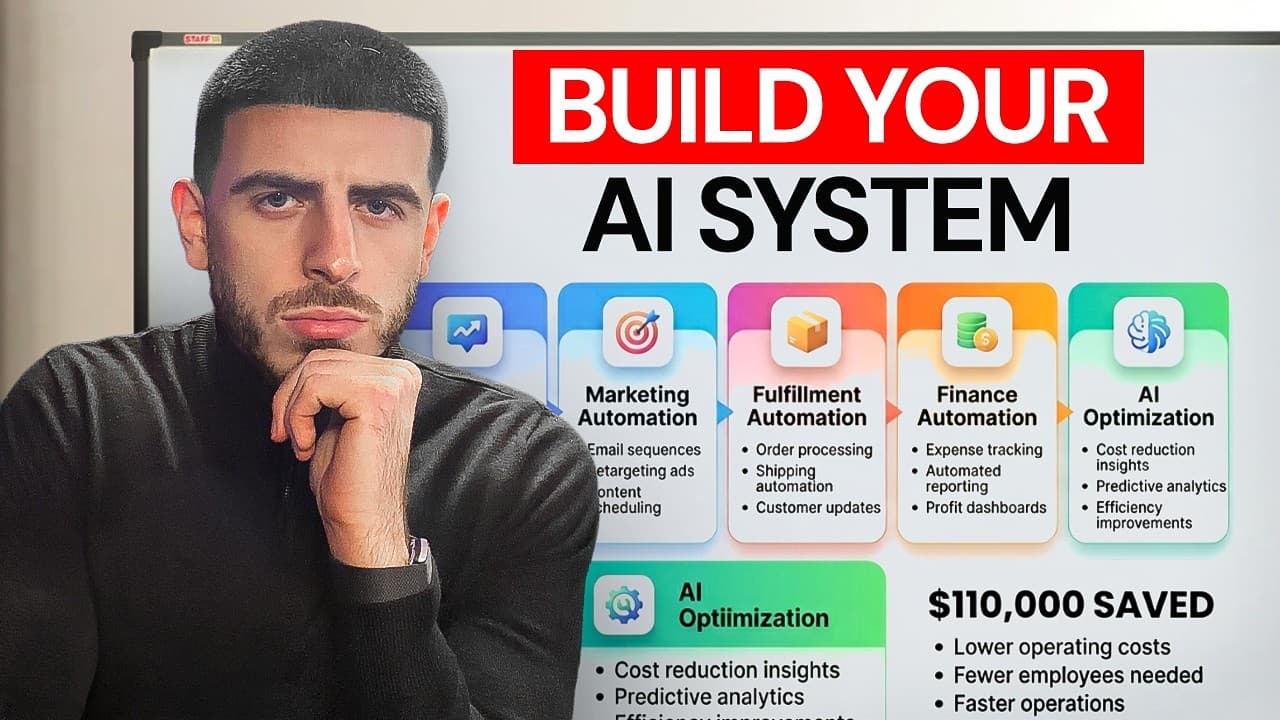
The £110k Hiding in Your Own Data: a Live AI Opportunity Audit in Recruitment
We sat down with a freight-forwarding recruitment firm and ran a live AI audit on the data they already owned: their LinkedIn network, their inbox, and a CRM full of candidates nobody had spoken to in over a year. Running that data through AI surfaced £110k of dormant pipeline they'd forgotten about, and showed that 30 to 40% of the team's week was going on admin a machine could do. The lesson for any service business is simple: the cheapest growth you have isn't a new lead, it's the data sitting idle in the tools you already pay for.
Read more