Why Your Paid Ads Aren't Working: 5 Reasons They Fail for Financial Services Firms

Kaiyan Ali
Founder at Montaj Digital

Kaiyan Ali
Founder at Montaj Digital
I'm Kaiyan, founder of Montaj Digital. I help professional service firms put AI and automation to work, so their people spend less time on admin and more on the work only humans can do. I've trained 250+ professionals at our AI Week, and I'm on a mission to help a million service firms do the same.
Follow me for more contentIf you've tried paid ads for your financial services firm before and it didn't work, it probably wasn't your fault, and it probably wasn't the ads. The issue is that most agencies fundamentally misunderstand how high-ticket regulated firms actually grow.
After managing hundreds of thousands in ad spend for wealth managers, brokers and advisory firms, I can tell you this with some confidence: paid ads aren't hard, they're misunderstood. Most agencies treat your firm like an e-commerce brand selling a £50 product, not a business closing £20,000, £50,000 or even £100,000 engagements. So they spend your budget on the wrong people, send traffic to the wrong places, track the wrong metrics, and then tell you they just need more time. The problem was never time. They never understood the business in the first place.
Below are the five reasons paid ads fail for financial services firms, and what actually needs to happen for them to work. If you'd rather watch than read, the full breakdown is here.
1. Your creative is your targeting now
The first reason paid ads fail is targeting, but not in the way most people mean it. Five years ago you could out-target a platform. You stacked job titles, interests, demographics and behaviours, and forced your ads in front of the right people. That world is gone.
Platforms like Meta now run on signals, and the strongest signal isn't your targeting setting, it's your creative. The algorithm doesn't find your customer. Your message does. Your videos, your statics, your hooks, your body copy and your calls to action are what tell the platform who the ad is really for. Put simply, your creative is your targeting.
If your hook speaks directly to a founder running a regulated firm with an inconsistent pipeline, someone tired of being the only rainmaker in the building, that's who stops scrolling. When your message names the things they live with, the compliance constraints, the long sales cycles, the high-trust decisions, the wrong people opt themselves out before they cost you a penny. That's how modern targeting works, and most agencies are still trying to solve it with 2019 tactics: obsessing over audience settings while ignoring message testing and signal quality.
If you want to know which angles your market responds to, you don't guess, you structure a test. Here's the exact framework we use:
- Start with deep persona research, not demographics. Get real clarity on what they're frustrated by, what they've already tried, what they're sceptical of, and the outcomes they want but won't say out loud.
- Define three to five core pain points. Not services or features. Actual business pains they feel every quarter.
- Write three to five hooks for each pain. Different openings, different angles, different pattern interrupts.
- Pair those hooks with one or two simple ad bodies. Keep the body plain so the hook does the work.
- Test one to three calls to action. Vary the ask, not just the wording.
Do the maths: five pain points, five hooks each, two bodies, three calls to action. That's 150 creative angles without changing your offer and without touching a single targeting setting, and it can be recorded in one sitting. Like a free market, you don't decide what works. The market does.
2. You're sending cold traffic to your homepage
The second reason is where the traffic lands. Most firms send cold ad traffic straight to their homepage. Homepages aren't bad, they're important, they build credibility. They just aren't built to convert cold traffic with a short attention span. A homepage tries to do too many things at once, and a cold prospect doesn't want all of it. They want the one thing they clicked for, and when they don't get it immediately, they leave.
What works instead is a dynamic lead capture: an experience built around high intent that gives the prospect exactly what they came for with as little friction as possible. In the video I show Checkmate Wealth's lead capture as a live example. Notice what it doesn't do. It doesn't explain everything, it doesn't pitch the services, and it doesn't ask for commitment up front. It meets the prospect where they are, asks the right questions, qualifies intent before a conversation happens, and adapts to what they enter, so it feels personal rather than generic. There's even a custom PDF report generated for the lead at the end.
That lead capture converts over 15% from cold traffic. For context, the industry average across financial services sits around 2 to 5%. It isn't magic, it works because the structure matches intent. Capture intent properly and lead quality improves, show rates climb, and sales cycles shorten. That's what monetising attention actually looks like, and it's the same principle behind the audit we walk through in the £110k hiding in your own data: the money is usually in the system, not the channel.
3. You have no follow-up system, so leads go cold
The third reason is the simplest to fix. Most firms generate a lead and then do nothing meaningful for 24, 48, sometimes 72 hours. By then the interest has decayed. High-intent prospects need speed, structure and consistency, and speed here means minutes, not hours. A same-day reply is already too slow.
A basic follow-up system has three parts:
- Immediate speed to lead. The moment someone opts in they get a confirmation, clear next steps, and a reason to stay engaged.
- A short reactivation and nurture sequence. Not dozens of emails. Five to seven touches over 7 to 14 days that reframe the cost of doing nothing, answer the common objections, and reopen the conversation.
- A light qualification before they book. A short assessment or a few diagnostic questions. It filters out the wrong people and raises commitment from the right ones.
The reframe worth keeping is this: ads don't create revenue, systems do. Ads buy attention. Follow-up turns that attention into a conversation. Structure turns conversations into paying clients. Skip the middle and you've paid for attention you let evaporate.
4. Your offer is safe, and safe is invisible
The fourth reason doesn't look like bad marketing. It looks like safe marketing: trusted, tailored, holistic, client-first. The problem isn't that any of it is wrong. The problem is that it's indistinguishable from every other firm saying the same words, and the best funnel in the world can't rescue a weak offer.
Most firms don't actually have an offer. They have a list of services. An offer answers one question: why should I engage with you now? In regulated markets this is where firms freeze. They strip out the specifics to stay safe, or they copy a competitor and hope trust does the rest. What works instead is structured clarity. A strong offer is specific about who it's for, clear on the problem it solves, honest about the process, and framed around outcomes without making promises. Diagnostics, benchmarks and assessments are all lead captures and offers that do this well, because they give something concrete before they ask for anything.
5. You're tracking vanity metrics, so you can't see the leak
The fifth reason is the most expensive: tracking the wrong metrics. This is where firms think they're being data-driven when they're really flying blind. Agencies love reporting on clicks, impressions and cost per lead. Those numbers look good on a slide and feel like progress, but in high-ticket financial services they're mostly vanity, because none of it matters if the leads don't convert.
Optimise for the wrong metric and you don't just waste money, you manufacture more leads that never show, more calls that go nowhere, and more noise for your team. Eventually you conclude that ads don't work, when the truth is you were measuring the wrong thing. What matters is the full funnel, from the first click through to revenue:
- Cost per lead
- Lead-to-appointment rate
- Appointment show-up rate
- Appointment-to-close rate
- Cost per client
- Return on ad spend
Track those and you can see exactly where the system breaks. Is it the ads, the offer, the lead capture, the follow-up, the qualification, or the sales process? Without the numbers, every optimisation is a guess. With them, growth becomes methodical. So stop asking how do we get more leads, and start asking where is the bottleneck in our acquisition system. Ads don't fail in isolation, they expose the weakness downstream. Pour more budget into a leaky funnel and you just spend faster. This is why most agencies can't scale an account: they optimise channels, when the job is to optimise systems.
The real problem isn't ads, it's guesswork
So those are the five reasons paid ads fail for financial services firms: targeting through creative, the destination of the traffic, the follow-up, the offer, and the metrics. The thread running through all of them is guesswork. Your last agency didn't fail because ads don't work. It failed because it optimised channels instead of building a system, and it never understood your business well enough to know the difference.
If you're a financial services firm doing over half a million a year in revenue and you want predictable growth without the whole thing depending on the founder, the next step isn't to try ads again. It's to diagnose what's actually broken first.
That's exactly what we do on a free campaign audit. Send us your previous campaigns and we'll show you where the leaks are, what went wrong, and the order we'd fix it in, whether you work with us afterwards or not. Book your free campaign audit here.
Got Any Questions? We have the answers.
If your question is not answered here, book a FREE AI readiness call and we can discuss it in detail.
Usually it isn't the ads, it's the system around them. The five most common reasons are: targeting through audience settings instead of creative, sending cold traffic to a homepage rather than a dedicated lead capture, following up too slowly, running a generic offer that blends in with every other firm, and tracking vanity metrics like clicks and cost per lead instead of the full funnel through to revenue. Fix those and the same ad spend performs very differently.


Learn with our resources
Stay informed with Our Latest InSights
How to Map Your AI & Automation Workflows
You can't automate a bad workflow. AI is only as good as the process you point it at, so the work that pays off happens before you touch a single tool: mapping what actually happens, step by step. This piece walks through how we do it, systems thinking over task thinking, the five whys to find the real cause of a broken process, six simple blocks for drawing any workflow, and a way to decide which tasks AI should run, assist with, or stay out of.
Read more
Why AI Isn't Optional Anymore: How to Stand Out in a World of AI
AI is not coming; it is already here, and it is already replacing tasks inside your job rather than the job itself. The wrong question is “will AI take my job?”. The right one is “which parts of my work are easy to replace, and how do I make myself valuable around them?”. Here is what still makes you stand out, and five frameworks to future-proof your work.
Read more
What to Automate First: The 5-Question Test We Run Before Touching a Workflow
Most businesses automate whatever felt annoying that week, and end up speeding up a mess. Before we touch a single workflow for a client, we score it on five weighted questions: time saved, revenue impact, error and quality risk, how repetitive it is, and how feasible it is to build. That gives a score out of 85 and a simple traffic light: 70 or more, automate now; 40 to 69, plan it; under 40, leave it. One reporting task scored 77 and handed my agency back eight billable hours a month.
Read more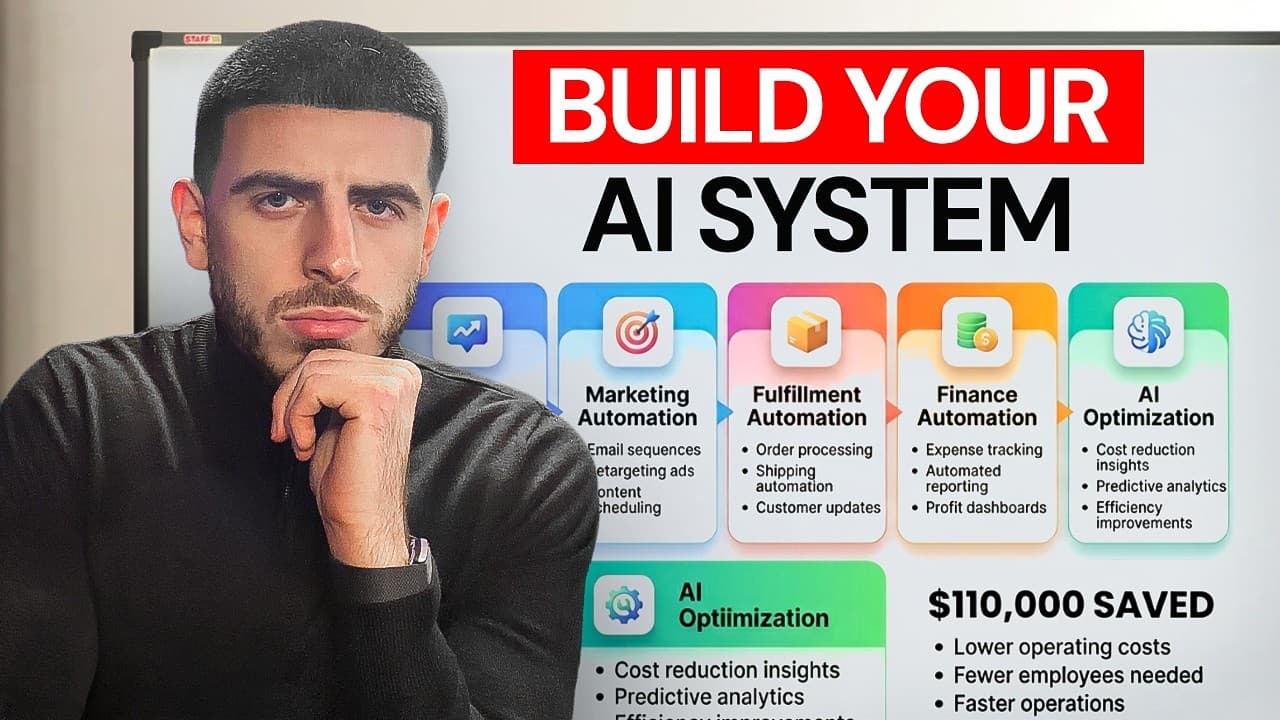
The £110k Hiding in Your Own Data: a Live AI Opportunity Audit in Recruitment
We sat down with a freight-forwarding recruitment firm and ran a live AI audit on the data they already owned: their LinkedIn network, their inbox, and a CRM full of candidates nobody had spoken to in over a year. Running that data through AI surfaced £110k of dormant pipeline they'd forgotten about, and showed that 30 to 40% of the team's week was going on admin a machine could do. The lesson for any service business is simple: the cheapest growth you have isn't a new lead, it's the data sitting idle in the tools you already pay for.
Read more
The AI Toolkit: Which AI Tools to Use in Your Business, and When
Stop asking which AI tool is best and start asking which tool for which job. An AI tool is a tool (brilliant at some things, useless at others), so you hire it for a defined job rather than collecting subscriptions. Sort every tool into six buckets (everyday AI, search and synthesis, a creative studio, autonomous agents, smart assets, and automation), hold one per bucket, and you've covered most of what a business does day to day.
Read more
How to Become an AI-First Company: a 5-Step Framework
Most businesses don't have an AI strategy. They have a few people using ChatGPT when they remember, a pile of subscriptions that don't talk to each other, and no way of knowing whether any of it's working. That's an AI-using company. An AI-first company is different: every tool has a clear job, an owner and a success metric, the knowledge is packaged so it plugs into any model, and improvement is actually measured. This is the five-step framework I use to close that gap: strategy, workflows, tools, knowledge and adoption.
Read more