Why AI Isn't Optional Anymore: How to Stand Out in a World of AI

Kaiyan Ali
Founder at Montaj Digital

Kaiyan Ali
Founder at Montaj Digital
I'm Kaiyan, founder of Montaj Digital. I help professional service firms put AI and automation to work, so their people spend less time on admin and more on the work only humans can do. I've trained 250+ professionals at our AI Week, and I'm on a mission to help a million service firms do the same.
Follow me for more contentThis was the keynote of our AI Week, and the least practical of the five sessions on purpose. The other talks send you away with things to do on Monday morning. This one is about changing how you think about AI, and understanding why it is no longer something you can put off. If you would rather watch than read, the full keynote is embedded here.
We are still incredibly early
If you feel overwhelmed by AI, you are in good company. I still feel overwhelmed and I do this for a living. I have spoken to some of the best AI minds in the world, people who worked at Google DeepMind and at the biggest software consultancies, and they are still getting their heads around a lot of it.
The reason it feels like that is that we are very early. Picture a chart where every block is 3.2 million people. Roughly 6.8 billion people have never used AI at all. About 1.3 billion use a free chatbot. Somewhere between 15 and 25 million actually pay for it. And only 2 to 5 million people would call themselves power users, the ones building dashboards, websites, applications and workflows. If you pay for even one subscription, you are already near the top of that pile. This is the wild west, and we are on a frontier most people have not stepped onto yet.
Where AI adoption really is
The AI adoption pyramid.
Power users
2-5 million
build dashboards, apps, workflows
Pay for AI
15-25 million
Use a free chatbot
1.3 billion
Never used AI
6.8 billion people
Pay for even one subscription and you’re already near the top.
It is also moving absurdly fast. Some estimates suggest that 90% of all the recorded data in human history has been created in just the last few years, which means we have produced about as much information in a couple of years as in the roughly 299,998 years humans walked the earth before that.
Most of the models you can use for free now exceed a human PhD baseline across science, maths and multimodal reasoning. One of Google's Gemini models won a gold medal at the International Mathematical Olympiad, putting it level with the best mathematicians alive. And yet the same class of top model can still only read an analogue clock correctly about half the time. That gap, brilliant and useless in the same breath, is the thing to hold in your head. AI is not uniformly clever. It is spiky.
AI isn't coming, it's already here
Go to a talk like this three years ago, and the message was “AI is coming”. It is not coming. It has been here a long time; it has just recently become something anyone can use. KPMG reported that in a single year, autonomous agents jumped from a 12% success rate on their tasks to 66%. You can now hand an agent a goal, and it will go and do the work with roughly a two-in-three chance of getting it right.
Set that against how most of us actually spend our week. A typical knowledge worker loses around 15 hours a week to admin: replying to emails, filling in spreadsheets, writing reports, summarising meetings.
McKinsey's data suggests that more than half of all recurring work hours in a typical service business are automatable with the technology everyone in the room already has, the kind of capability that until recently only the largest and wealthiest companies on earth could touch. The gap is not access anymore. It is knowing how to get value out of it.
Leverage: why this is not about replacing people
Archimedes said, “give me a place to stand and a lever long enough and I will move the world.” Leverage is simply how much output you get from an input. Put one unit in and get two out, you have leverage. Put one in and get half back, you have a hindrance. There are four broad kinds: labour (hiring and building a team), capital (buying your way into rooms, companies, or time with someone who knows the answer), code (now far more accessible, though plenty of people build things that fall apart under real use or get hacked by a curious teenager), and media (recording yourself so this talk can be watched by far more people in five years than were ever in the room).
How you multiply your effort
Four types of leverage.
Labour
Hiring and building a team.
Capital
Buying your way into rooms, companies, or time with people who know the answer.
Code
More accessible than ever, though shaky builds fall apart under real use.
Media
Record once; reach far more people over time than were ever in the room.
Once you see AI as leverage, the people worried about it taking jobs are looking at it wrong. I don't think you should fire your team because of AI. If that thought crosses your mind, you probably hired the wrong people, or you do not understand the task you are asking them to do. What you should be doing is amplifying them.
In my own network, the owners and executives who are applying AI properly are hiring faster, not slower, spending serious money every month on people who can actually implement these systems.
A few years ago my agency ran on pods: a manager, an account manager handling the day-to-day, a designer, a media buyer running the ads. A pod like that could handle about 20 clients. Hit the 21st, and you faced two bad options: overhire and destroy your margins, or overwork the team until quality dropped, people burned out, and you lost clients back down to 20 anyway.
That was the game. When we started amplifying each role with AI, tools, agents and processes behind every person, the same pod could carry far more.
The businesses getting this right are not firing anyone. They are getting two to five times the revenue per head from the same team, which matters enormously in a tight UK economy where margin is everything. The verifiable studies back it up: AI super users are delivering around five times the productivity of their peers.
“I'm a self-declared AI novice. It's not often you get education and personability together. He took a subject that is quite in-depth and brought it to life with real-world, practical solutions. My key takeaway is to book a meeting with Montaj Digital.” (Johnny Harvey, General Manager, Sópers House, AI Week)
Stop asking whether AI will take your job
Many people are asking, “Will AI replace my job?”
AI is already replacing tasks in your job, so the better question is “which parts of my work are easy to replace”, and then position yourself around what is left.
AI lowers the value of simple work. If a task is easy to explain, easy to repeat, easy to check, or easy to outsource, AI will compress its value, if it has not already.
It helps to think of today's AI as a junior employee who is eager, tireless, and never off sick, and who learns about a thousand times faster than any human, going from junior to vice-president-level knowledge in a couple of weeks.
Incredibly capable, and still a junior. So the work that stays safe, the work to lean into and build your role or business around, tends to be one of four things:
- Genuinely complex work that needs many moving parts held together at once.
- High, nuanced context drawn from lots of different places. Models can hold one to two million tokens of context, but scattered, subtle context is still hard.
- High stakes, where a mistake is expensive or dangerous. AI is remarkable at spotting pre-cancerous conditions in medical imaging, yet none of us goes to AI instead of a doctor, because it is genuinely life or death and the technology is not there.
- Hard to judge without expertise. AI predicts the next most likely outcome from what already exists. It struggles with things that do not exist yet.
What actually makes you valuable now
It helps to see where value has moved over time. In 1200, a wealthy family with a private library could read and write when most people couldn't, so knowledge itself made you valuable. The printing press in the late 1400s spread that knowledge, so the edge became internalising it. Google and the internet in the 2000s let almost anyone know almost anything, so the edge moved again, to application and filtering, which is why people got degrees to become masters of a subject. In 2026, when you have access to anything, anywhere, all the time, the valuable thing is deep, complex expertise rather than surface-level knowledge. Access is democratised. Memory is no longer the impressive trait it was.
Two things underline why expertise still wins.
The first is hallucination: AI will confidently tell you it is not raining while you watch it rain, and it always will, because a large language model always predicts the next likely outcome and will invent a path if it has not been given proper context. If you use AI to make yourself an instant expert on a subject you know nothing about, you will believe wrong answers, because you have nothing to challenge them with.
The second is that company values are shifting. Businesses used to ask how much work someone does and how good it is. Now they also ask how much better this person is than the AI, how much genuine nuance and judgement they bring to unusual situations, and how much risk they remove. A big company thinking about automating something asks: even if AI is 95% right, what happens the other 5% of the time, and how much would we pay to get to 99.9% certainty? That is exactly why they keep hiring the best people to amplify the business rather than replace it.
How the edge keeps moving
Where value has moved over time.
1200
A private library
Being able to read and write at all.
Late 1400s
The printing press
Internalising knowledge as it spread.
2000s
Google & the internet
Application and filtering; mastering a subject.
2026
Access to everything
Deep, complex expertise, not surface knowledge.
Five frameworks to future-proof yourself
Here are the five frameworks I use to stay valuable, and to make my own business hard to replace.
1. The flight deck: cruise, co-pilot or captain
A modern plane has three modes, and so should your use of AI. Cruise is for tasks with little or no variance, the same process every time, like turning a meeting transcript into an action list. Co-pilot is take-off and landing: the system does a lot but you still run the checks. Use it for valuable, nuanced work that improves through iteration, like building a client growth strategy that used to take a week and now takes a few hours, as long as you do not hand all your thinking away. Captain is turbulence and emergencies, and anything high stakes: pricing, scoping, negotiating, sensitive conversations, legal or financial claims. You stay in control.
Before you use AI on anything, run a quick flight deck check. Ask how long the task takes you by hand, how likely AI is to produce something good enough, and how long it takes to brief, review and fix. If a task takes an hour by hand, five minutes with AI, and 45 minutes to correct, it is often not worth it. The real skill is choosing the right mode each time. AI should not replace your judgement. It makes judgement more valuable.
Three modes of using AI
The flight deck.
Software runs it
Low/zero variance, same process every time (e.g. transcript → action list).
AI drafts, human reviews
Valuable, nuanced work that improves through iteration (e.g. a client growth strategy).
Human only
High stakes: pricing, scoping, negotiating, legal or financial claims.
Flight-deck check
- 1How long by hand?
- 2How likely is AI to nail it?
- 3How long to brief, review & fix?
2. Amplify your workflows
The point is not to do the task now, but to design a system that does it for you. If half your work could be handed off and you are still doing it, faster people are already out-competing you. Harvard and Boston Consulting Group tested 758 consultants, some of the smartest, best-paid people around. Their top performers split into two groups: centaurs, who divided tasks between themselves and AI with clear handoff points (a human in the loop), and cyborgs, who wove AI into every step. A third group used AI with no structured process, just hoping it worked. Their output was 19% worse, and that is among 758 of the sharpest people in the world, which means the gap is probably far wider for everyone else.
To build your first workflow: choose a recurring deliverable, break it into stations (everything you do is a set of steps, right down to making a bowl of cereal), assign each station a mode (cruise, co-pilot or captain), automate the cruise steps first, and add a quality-control point where a human reviews before anything goes out. Then amplify it with context, because most people start every chat from scratch.
Give your AI three things:
- Clear instructions (who you are and how you want it to work, including permission to question you and ask clarifying questions)
- History (what good looked like last time)
- Knowledge (a structured store of your business).
I built mine as a second brain, layered from a business master (overview, tone of voice, team and who does what) up through operations, marketing, sales, and a folder for each client, all as plain files that humans and AI can both read. It matters because AI runs on a token budget: give it a clear path to the right answer, like telling a student to study chapter three rather than the whole textbook, and it stops burning through credits guessing.
A structured store your AI can read
Your second brain.
Tier 01 · Business Master
Business Master
Overview, tone of voice, team, who does what.
Department
Operations
Department
Marketing
Department
Sales
Tier 03 · One folder per client
All as plain files humans and AI can both read.
Once that exists, useful things happen. My “coffee protocol” runs every morning at 7am: a scheduled chat, plugged into Notion, Slack, Gmail, Fathom and Google Drive, reads everything and writes me a structured daily brief before the team huddle, my top priorities, my schedule, what the team did in the last 24 hours, and a watch list.
It is not perfect. It once told me I had no prep needed for a day full of client and one-to-one meetings, so I corrected it, told it what prep each meeting type needs, and it learned. The bigger unlock was a single reporting workflow that saved 16 hours a week. Pulling ad metrics, updating a spreadsheet, drafting a performance email and queuing it for my review was repetitive, and honestly more error-prone by hand than by machine, because it is just moving data from A to B.
Mapped and automated, it went from 16 hours a week to 30 minutes of me reviewing. Worth noting: there is barely any AI in that automation. A workflow is a workflow, and automation has been around for years, which is the whole point of how to map your AI and automation workflows. To judge whether one is worth building, track the time it removes, the cost impact, how consistent the output is (inconsistent output is a hindrance, not an accelerator), and the return: savings plus revenue uplift, minus the cost, divided by the cost.
3. Curate taste
AI can create, but it can't curate. It can produce something, but it does not know what good looks like, and you do. So build your own library of the best examples in your field: the best websites, ads, landing pages, emails and thought leadership you come across. For each, ask what makes it good, the hook, the structure, the call to action, and cherry-pick what to copy and what to avoid. Then run a feedback loop: collect examples, study them, create, compare, refine, launch, and repeat until a process that started doing half the job is doing 90% of it. I automated even the collecting: a screenshot on my phone drops into a chat, and an automation files it to Google Drive and Notion so the whole team has an ever-growing swipe file.
One more habit here: stop drinking from the same pond. If everyone in your field reads and watches the same things, you all end up saying the same things slightly differently. Go to the sources your favourite authors learned from and read those directly. I take inspiration from outside my industry entirely: fashion, cars, travel.
I once got taken apart by the salesmen in Istanbul's Grand Bazaar: free tea, a bit of chat about my family, and suddenly I had bought five things I didn't necessarily need. Then I spent the walk home working out exactly what they had done and how to use it.
4. Tell better stories
As AI makes it trivial to produce more of everything, human attention is shrinking, and the gap between the two is where most products and ideas quietly die. AI cannot generate meaning. Social posts, LinkedIn, and landing pages are all starting to look the same because AI has no taste and cannot tell a story that moves anyone. The real skill is turning information people already have into something they actually care about, so they listen to you rather than the next identical thing.
Most people tell a story as “this happened, then this happened, then this happened, and now I am bored”. Two frameworks fix that.
Framework 1: And, but, therefore. The “and” sets the scene, the “but” introduces a conflict people lean into, and the “therefore” resolves it with a clear next step.
Framework 2: SCQA. Situation, complication, question, answer. I use it with clients constantly. I'd never walk in and say “we have a problem”. Instead, I'd say: here is the situation, here is the obstacle, here is what I need from you, and here is where that gets us.
People buy in because both frameworks introduce a tension and then resolve it. It works on a marketing campaign, on your team, and even on your AI when you brief it.
5. Think for yourself first
I put this last because it is the one I worry about most. Sceptics say AI will make us dumber. Plato worried that writing would erode wisdom, and writing turned out to be how we passed wisdom across generations.
AI only hurts you if you let it change your habits. TV is not bad, chocolate is not bad, AI is not bad, but doing nothing but any of them all day is.
Going to a chatbot to write an email without doing any thinking is the bad habit. So form your own view first: spend a few minutes on your own position before you ask anything, make your own decision, then seek feedback. And play devil's advocate with the machine, ask it “is that true, what about this, why not think about it this way”, and you will end up somewhere better than the average answer everyone else is getting.
Final words
There is a lot of doom and hype out there: no jobs, universal basic income, software development is dead, coaching is dead. The reality is calmer and more demanding.
So run the flight deck check on your tasks, amplify and build your workflows, curate your taste, learn to tell a story people buy into, get your mind out of the weeds now and then, and stop giving all of your thinking away.
If you would rather start with something you can action on Monday, the practical sessions are the seven AI quick wins and the AI toolkit.
If you want a clear read on where you stand today, a free AI audit looks at your real workflows and gives you a prioritised first step. You can watch the rest of AI Week, or see how we help businesses put this to work with AI and automation implementation.
Got Any Questions? We have the answers.
If your question is not answered here, book a FREE AI readiness call and we can discuss it in detail.
Because AI is already here and already doing a share of everyday knowledge work. More than half of recurring hours in a typical service business are automatable with tools everyone can now access, and people who use AI well are producing several times the output of those who do not. Ignoring it does not keep things as they were; it just means being out-competed by people and businesses who have folded it into how they work.


Learn with our resources
Stay informed with Our Latest InSights

Why Your Paid Ads Aren't Working: 5 Reasons They Fail for Financial Services Firms
If you've run paid ads for your financial services firm and they didn't land, the ads probably weren't the problem. Most agencies treat a firm closing £20k to £100k engagements like an e-commerce brand selling a £50 product, so they target the wrong way, send traffic to the wrong place, and report on numbers that don't matter. Here are the five reasons paid ads fail for regulated, high-ticket firms, and the fix for each: your creative is now your targeting, cold traffic needs a lead capture not a homepage, follow-up has to happen in minutes, a safe offer is an invisible one, and vanity metrics hide where your system is actually breaking.
Read more
How to Map Your AI & Automation Workflows
You can't automate a bad workflow. AI is only as good as the process you point it at, so the work that pays off happens before you touch a single tool: mapping what actually happens, step by step. This piece walks through how we do it, systems thinking over task thinking, the five whys to find the real cause of a broken process, six simple blocks for drawing any workflow, and a way to decide which tasks AI should run, assist with, or stay out of.
Read more
What to Automate First: The 5-Question Test We Run Before Touching a Workflow
Most businesses automate whatever felt annoying that week, and end up speeding up a mess. Before we touch a single workflow for a client, we score it on five weighted questions: time saved, revenue impact, error and quality risk, how repetitive it is, and how feasible it is to build. That gives a score out of 85 and a simple traffic light: 70 or more, automate now; 40 to 69, plan it; under 40, leave it. One reporting task scored 77 and handed my agency back eight billable hours a month.
Read more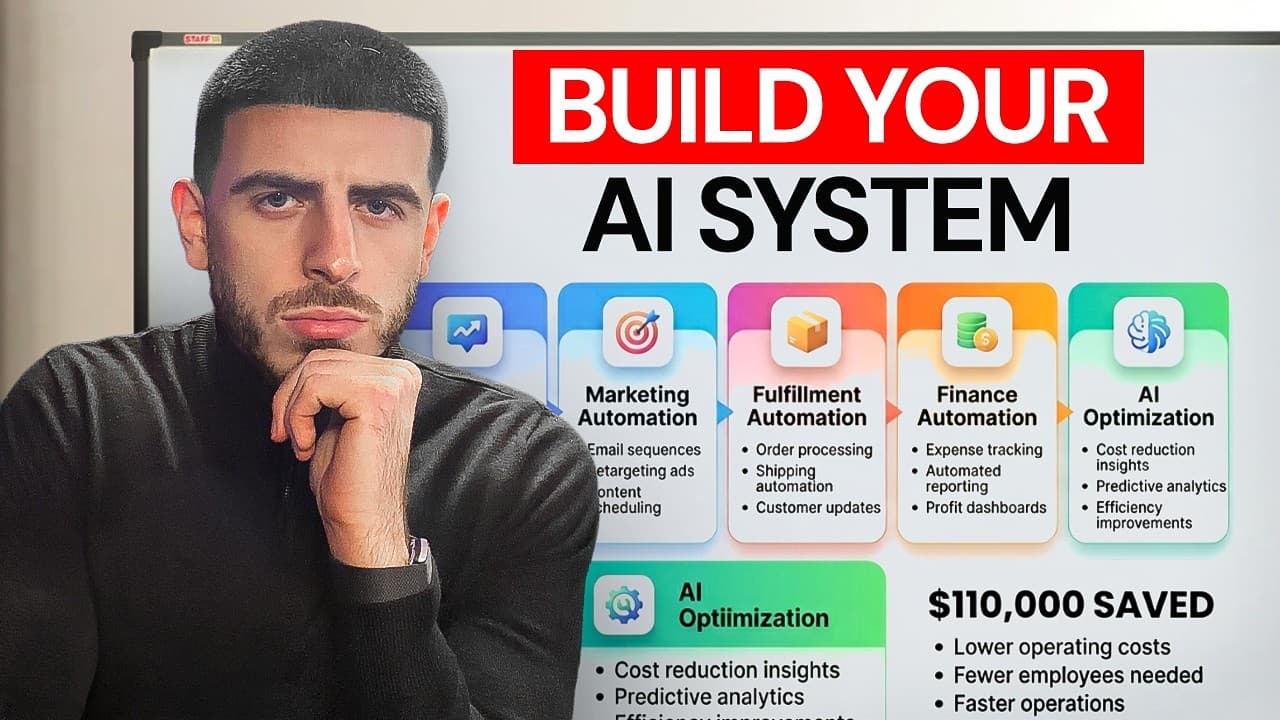
The £110k Hiding in Your Own Data: a Live AI Opportunity Audit in Recruitment
We sat down with a freight-forwarding recruitment firm and ran a live AI audit on the data they already owned: their LinkedIn network, their inbox, and a CRM full of candidates nobody had spoken to in over a year. Running that data through AI surfaced £110k of dormant pipeline they'd forgotten about, and showed that 30 to 40% of the team's week was going on admin a machine could do. The lesson for any service business is simple: the cheapest growth you have isn't a new lead, it's the data sitting idle in the tools you already pay for.
Read more
The AI Toolkit: Which AI Tools to Use in Your Business, and When
Stop asking which AI tool is best and start asking which tool for which job. An AI tool is a tool (brilliant at some things, useless at others), so you hire it for a defined job rather than collecting subscriptions. Sort every tool into six buckets (everyday AI, search and synthesis, a creative studio, autonomous agents, smart assets, and automation), hold one per bucket, and you've covered most of what a business does day to day.
Read more
How to Become an AI-First Company: a 5-Step Framework
Most businesses don't have an AI strategy. They have a few people using ChatGPT when they remember, a pile of subscriptions that don't talk to each other, and no way of knowing whether any of it's working. That's an AI-using company. An AI-first company is different: every tool has a clear job, an owner and a success metric, the knowledge is packaged so it plugs into any model, and improvement is actually measured. This is the five-step framework I use to close that gap: strategy, workflows, tools, knowledge and adoption.
Read more