
AI implementation for service businesses: start with process, not tools

Kaiyan Ali
Founder at Montaj Digital

Kaiyan Ali
Founder at Montaj Digital
I'm Kaiyan, founder of Montaj Digital. I help professional service firms put AI and automation to work, so their people spend less time on admin and more on the work only humans can do. I've trained 250+ professionals at our AI Week, and I'm on a mission to help a million service firms do the same.
Follow me for more contentMost businesses ask the wrong first question. They ask, "Which AI tool should we use?" The better question is much less exciting and far more useful: "What does our business actually do, step by step, and where would AI make that better?"
I talked about this with Josh Peacock on The Agency Growth Club. Josh runs Search For Hire, a specialist recruitment firm for SEO, Paid Media and Growth teams, so his side of the conversation was useful. He sees which companies are trying to replace people with AI, and which ones are hiring stronger operators who can use it properly.
That distinction matters. AI doesn't rescue weak processes. It exposes them. If the business already runs on unclear handovers, scattered knowledge and decisions nobody owns, adding AI usually makes the mess move faster.
Everyone has the same AI tools now
Access isn't the edge anymore. Your competitors can use the same models, the same prompt libraries and the same automation platforms. They can buy the same £20-a-month subscription and ask the same broad questions.
The advantage is the context layer around the tool. What does it know about your customers, your sales calls, your objections, your delivery process, your tone of voice, your pricing rules and the lessons your team has earned the hard way?
Most teams skip that layer. They give people a chatbot, maybe a few saved prompts, and hope useful work appears. Sometimes it does. More often, five people use AI in five different ways and nobody can tell whether the output is any good.
If you want the deeper workflow mapping version of this, start with how to map your AI workflows. The short version is simple: the tool only gets useful once the business around it is clear.
AI doesn't work on top of weak process
A job is a series of tasks. A task is a series of actions. Once you can see work at that level, you can decide what should stay human, what AI can assist with and what software can run on its own.
Before that point, you're guessing. If nobody can explain how a client gets onboarded, who checks the documents, where the kickoff notes go or what happens when something is missing, AI has nothing solid to work with.
That is why AI implementation starts with process mapping. Pick one workflow and write down what really happens, not what the SOP says in the folder nobody opens. Where does it start? Where does it finish? Who owns each step? What context does each action need? What decision has to happen before the work moves on?
When the process is visible, the AI decision gets easier. Some actions belong with a human because judgement, taste or trust is involved. Some actions are perfect for AI draft and human review. Some actions are repetitive enough to automate properly.
Build a private AI operating system, not a collection of automations
Random automations are easy to build and hard to live with. A private AI operating system is different. It is the structured business brain, the workflows that use it and the rules that keep the whole thing from drifting.
For a service business, the useful version usually includes:
- A central knowledge base for customer language, delivery notes, sales objections, tone of voice, pricing logic and internal know-how.
- Mapped processes for the workflows you run every week, starting with the ones that create the most drag.
- Department context so sales, marketing, delivery, finance and leadership aren't all pulling from the same vague pile of notes.
- Role-specific AI setup so each person has the tools, accounts and examples they need for their actual job.
- Connected tools and MCPs where they remove manual copying, not because every logo in the SaaS stack needs to be connected on day one.
- Clear ownership for context changes, because a sales insight shouldn't silently rewrite the company's marketing strategy.
This doesn't need to sound grand. In practice, it often starts as a clean folder structure, a few well-written instructions, a mapped workflow and one useful automation. The point is that it becomes a system the team can trust, not a pile of experiments.
That is the same direction behind becoming an AI-first company: fewer tools, better context, clearer habits.
Onboard AI like you onboard a team member
This is the part most businesses miss. They assume the team is using AI properly because everyone has access. In reality, half the team might not have the right accounts connected, and the other half are asking questions without any company context.
Treat AI onboarding like employee onboarding. Don't just hand someone a login and hope they work out the culture by Thursday.
- Give each person the approved tools and make sure they can actually access them.
- Connect the right accounts, documents and apps for their role, with permission levels that match the work.
- Show them where the company context lives and which source wins when two documents disagree.
- Give examples of approved use: research, first drafts, meeting summaries, workflow checks, QA, reporting or internal planning.
- Define what they can't send without approval, especially client work, pricing, legal language, finance, strategy and anything that changes shared company context.
- Review the setup weekly at first. Keep what saves time, fix what creates noise and delete anything nobody uses.
The weekly review is where the system improves. You will spot prompts that confuse people, old documents that keep resurfacing, approval steps that are too slow and tasks that should never have been automated in the first place.
Human in the loop is a leadership decision
Human approval isn't a technical detail. It is a leadership decision about risk. The question is simple: what happens if this output is wrong?
If the answer is "a client sees it", "money moves", "legal risk appears", "the brand sounds wrong" or "the company starts making decisions from bad context", a person belongs in the loop.
At company level, context needs owners. Sales insights go to the sales or revenue lead. Marketing insights go to the marketing lead. Finance context goes to finance. Executive context stays under leadership review.
This gets more important as the company gets larger. Bad context compounds. One wrong assumption in a team of 5 is annoying. One wrong assumption pushed into 40 workflows is expensive.
AI changes hiring, but it doesn't remove judgement
Josh's hiring lens was useful because recruitment shows the change clearly. The companies moving fastest aren't just cutting headcount. They are hiring better people and giving them leverage.
One excellent operator with a well-built AI system around them is worth more than a larger team doing repeatable work badly. That doesn't mean people stop mattering. It means the bar rises. Taste, judgement, communication and ownership matter more when the repetitive work gets cheaper.
There is also a plain cost point people avoid. AI usage is still heavily subsidised in many places. API costs can rise. Models can get more expensive. If your whole plan is "replace everyone with AI because it is cheap today", the economics are shakier than they look.
The better model is leaner teams with stronger operators. Less admin, more leverage, and still very human where the work calls for it.
What to do first this week
Don't start by mapping the whole business. Pick one workflow with obvious drag. The one that annoys the team every week is usually a decent place to begin.
- Write down every task in that workflow.
- Break each task into the actions someone takes to complete it.
- Mark each action as human, AI-assisted or automated.
- Pull the context each action needs into one place.
- Add a review step before anything reaches a client or changes company context.
- Test it with one person before rolling it out to the whole team.
If you want a scoring model for choosing the first workflow, use the automation priority matrix. If you're already convinced but don't know where the risk sits, the AI implementation page explains how we approach the build.
Watch the full conversation
Josh and I covered this in more detail on The Agency Growth Club, including AI hiring, company brains, AI onboarding, taste, team structure and why the best use of AI is often amplifying your best people rather than replacing them.
You can also watch the episode on YouTube or visit Search For Hire.
Got any questions? We have the answers.
If your question isn't answered here, book a free AI readiness call and we'll talk it through.
AI implementation is the process of putting AI into real business workflows, not just giving the team access to a chatbot. It usually includes process mapping, business context, tool setup, training, governance and measurement.


Learn with our resources
Stay informed with Our Latest InSights

Build your AI second brain: stop starting from scratch with AI
Most businesses still use AI like a scratchpad: open a new chat, explain the business again, get an answer, then start from scratch next time. This replay shows how to build a portable context layer from source files, reviewed knowledge, an index and a log, so AI can work from what your business already knows.
Read more
Why Your Paid Ads Aren't Working: 5 Reasons They Fail for Financial Services Firms
If you've run paid ads for your financial services firm and they didn't land, the ads probably weren't the problem. Most agencies treat a firm closing £20k to £100k engagements like an e-commerce brand selling a £50 product, so they target the wrong way, send traffic to the wrong place, and report on numbers that don't matter. Here are the five reasons paid ads fail for regulated, high-ticket firms, and the fix for each: your creative is now your targeting, cold traffic needs a lead capture not a homepage, follow-up has to happen in minutes, a safe offer is an invisible one, and vanity metrics hide where your system is actually breaking.
Read more
How to Map Your AI & Automation Workflows
You can't automate a bad workflow. AI is only as good as the process you point it at, so the work that pays off happens before you touch a single tool: mapping what actually happens, step by step. This piece walks through how we do it, systems thinking over task thinking, the five whys to find the real cause of a broken process, six simple blocks for drawing any workflow, and a way to decide which tasks AI should run, assist with, or stay out of.
Read more
Why AI Isn't Optional Anymore: How to Stand Out in a World of AI
AI is not coming; it is already here, and it is already replacing tasks inside your job rather than the job itself. The wrong question is “will AI take my job?”. The right one is “which parts of my work are easy to replace, and how do I make myself valuable around them?”. Here is what still makes you stand out, and five frameworks to future-proof your work.
Read more
What to Automate First: The 5-Question Test We Run Before Touching a Workflow
Most businesses automate whatever felt annoying that week, and end up speeding up a mess. Before we touch a single workflow for a client, we score it on five weighted questions: time saved, revenue impact, error and quality risk, how repetitive it is, and how feasible it is to build. That gives a score out of 85 and a simple traffic light: 70 or more, automate now; 40 to 69, plan it; under 40, leave it. One reporting task scored 77 and handed my agency back eight billable hours a month.
Read more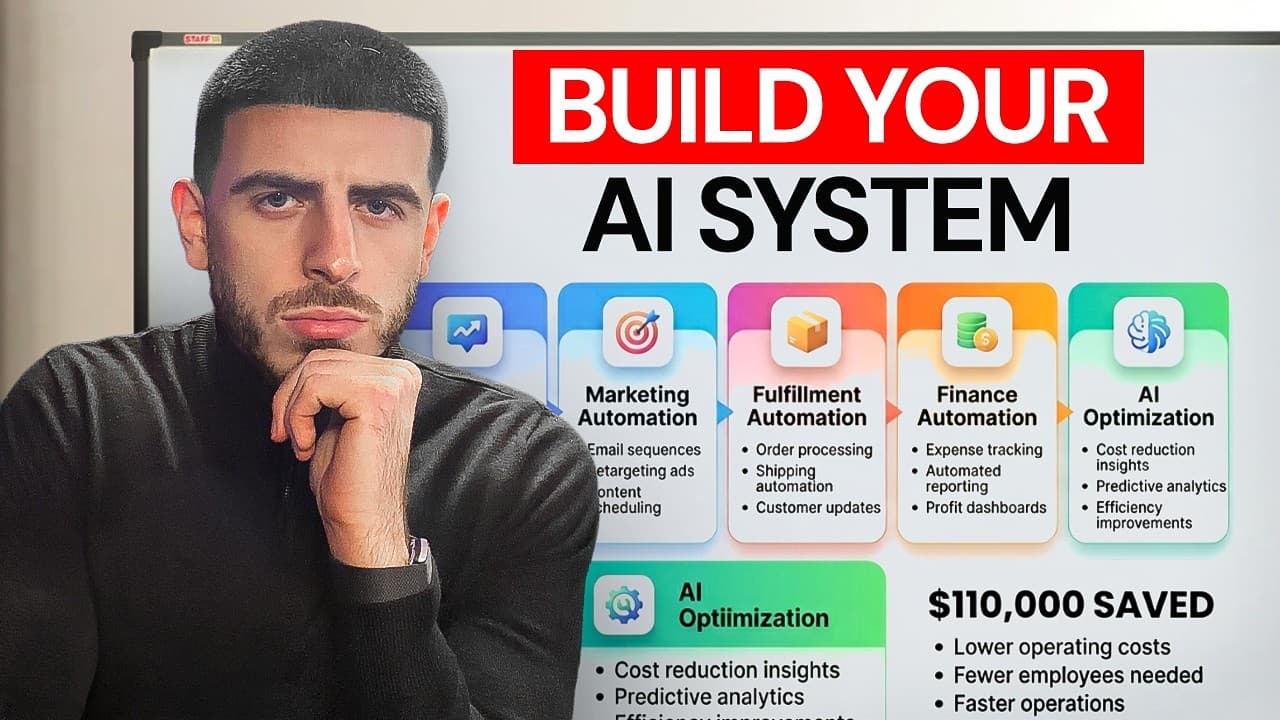
The £110k Hiding in Your Own Data: a Live AI Opportunity Audit in Recruitment
We sat down with a freight-forwarding recruitment firm and ran a live AI audit on the data they already owned: their LinkedIn network, their inbox, and a CRM full of candidates nobody had spoken to in over a year. Running that data through AI surfaced £110k of dormant pipeline they'd forgotten about, and showed that 30 to 40% of the team's week was going on admin a machine could do. The lesson for any service business is simple: the cheapest growth you have isn't a new lead, it's the data sitting idle in the tools you already pay for.
Read more